

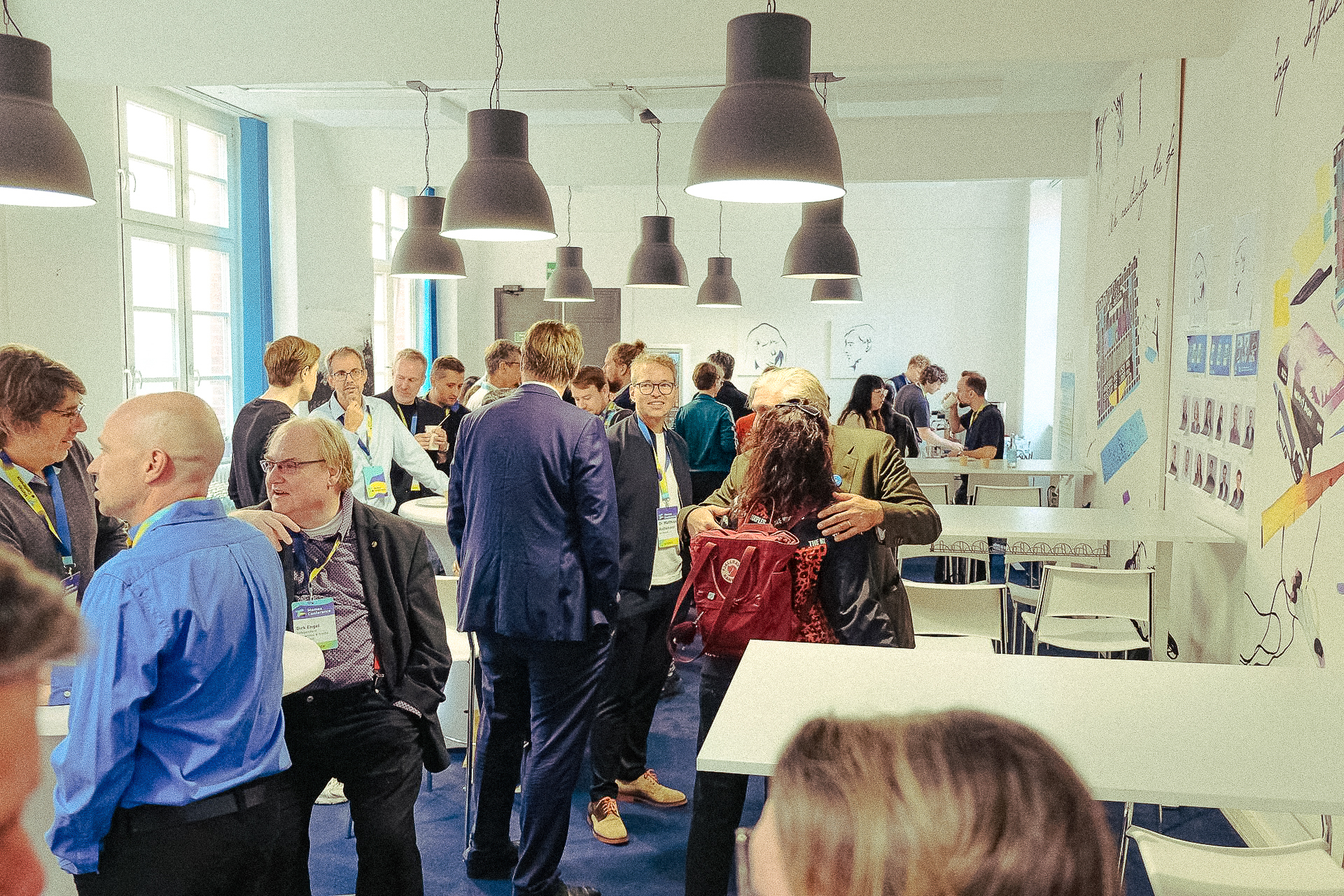
At MEMEX 2026, experts from market research, marketing, media, and technology came together to discuss current developments around artificial intelligence, attention, and consumer behavior.
The discussion focused on how human perception and brand communication are changing in an increasingly AI-driven media world, as well as what new requirements emerge for research and advertising as a result.
The contributions showed, among other things, how AI-generated content is perceived, the role attention and emotions play in brand effectiveness, and how new advertising formats and modern measurement methods like eye tracking and facial expression tracking can help better understand the impact.
At the same time, it became clear that technological possibilities alone are not enough: It remains crucial to place human behavior, needs, and emotions at the center and to connect AI with well-founded data and research.


MEMEX 2026 opened with a thought-provoking keynote by Michael Schiessl, CEO of eye square, exploring one of the most pressing questions of our time: What happens to human attention in an era dominated by artificial intelligence? Schiessl grounded his talk on the three pillars that define eye square's identity: Psychology, Science and Technology. These pillars shape not only the company's vision and daily work but also its understanding of people themselves. It is people that are at the company's current phase as its "4th Wave of Development: The Human Experience“.
For Schiessl, Human Experience (HX) means empathy and human quality, and he cautioned against pure digitalization: "No digital can reflect (on) the digital." We need and will come up with concepts to describe and analyze what is happening. One central concept is Artificial Attention (AA). For explaining this, Schiessl contrasted the trajectories of artificial and human attention in striking terms.
Artificial systems, he noted, as extraterritorial systems, develop in exponential fashion—ever more speed, ever faster, seemingly without limits. Human attention, by contrast, is fundamentally limited - defined by the human body. Schiessl drew on a quote from philosopher Edith Stein, who described the body as an object—but also not an object, because it is partially hidden. The body has a backside, gaps, and shadows that cannot easily be objectified, and thus the human body is not fully described. To make this experiential rather than abstract, Schiessl played a triangle live on stage and asked the audience: “What happens in your systems of experience—0, 1, 2 (sensual, emotional, rational)?” The moment served as a vivid demonstration that perception is layered and embodied, not merely informational.
Exponential Machines, Logarithmic Humans - Schiessl's central insight, based on the Weber-Fechner-Laws and proven by eye square research led by Rothensee/Güdenpfennig—was a mathematical one: 1) Reality is not exponential—it works in curves, rising and falling like sine and cosine waves. 2) Human experience follows a logarithmic, psycho-physical function—not an exponential path toward infinity. One additional stimulus creates more impact when there are few other stimuli—but little when there are already a lot. (To double subjective noise, for example, sound has to be increased tenfold.) 3) Notably, even LLMs and human-built networks learn logarithmically: more and more data is required for ever-decreasing additional benefits.
The task he set before the audience of researchers and communicators was clear: the infinite, exponential external world must be connected to the limited, logarithmic human being. Schiessl closed on a deeply human note, reminding the audience that human experience is built on enduring values—justice, love, and courage—that can only be realized through empathy, which machines do not possess. In an age of Artificial Attention, the message is unmistakable: the measure and nexus of technology must remain the human being.

Prof. Dr. Jana Möller-Herm from UdK addressed a challenge every brand now faces: designing AI-powered communication that consumers actually embrace. Her starting point was a structural shift in the advertising landscape: transparency obligations now make AI disclosure obligatory. People can know when something is AI-generated—and they react accordingly. Her diagnosis was sharp: AI buys attention cheaply but pays for it in attitude. In other words, attention and acceptance have become disconnected—a consumer may engage with an AI-generated ad while liking it less. Drawing on a range of current studies, Möller-Herm identified a clear trend: general AI aversion is giving way to more specific, situational rejection.
Crucially, she stressed that this is not caused by poor quality, privacy worries, or general aversion. The real casualty is the parasocial connection: AI is perceived as lower effort, and that perception quietly erodes the human bond between creator and audience.
Three Tensions That Define AI Communication
In a striking experiment, ads were created using faces resembling users' own social media photos, tested across ten grades of similarity—from 10% to 100%. The results revealed an inverted U-shape: acceptance rises with similarity, peaks at roughly 57% similarity, and then collapses. The "too-similar-to-me effect" triggers rejection above the ~60% mark. The lesson: mega-personalization has an optimum, not a maximum. Notably, when consumers can customize ads themselves, psychological ownership, responsibility, and behavioral intentions all increase.
When AI produces superhuman, "perfect" products, it feels threatening—and sabotages perception. The remedy: make special effort visible. This is especially critical in the luxury segment, where AI use is otherwise particularly detrimental—because people are, in effect, paying for human effort.
AI-created virtual influencers may credibly assess brands, but they cannot deliver proximal judgments—sense, touch, taste—which matter enormously in many product categories. Her concept of "the word of machine" (as opposed to word of mouth) showed that AI recommendations are accepted for rational products, but not for hedonic experiences like emotions and entertainment. Two further nuances: 1) Human–AI cooperation (augmented intelligence) is significantly more accepted than pure AI. And 2) AI is perceived as having no selfish intent, so bad news is more easily accepted from AI—while good news is more authentically expressed by humans.
Möller-Herm distilled her research into five actionable principles for marketers:
Her closing message resonated as the perfect counterpoint to an AI-driven industry: acceptance isn't won by hiding the machine—it's won by designing around the human.

Guido Modenbach (SevenOne Media) delivered a provocative presentation at MEMEX, opening with a statistic guaranteed to unsettle any brand manager: 78% of brands could vanish without anybody noticing. And they could, easily—because survival requires constantly rebuilding your customer base. Brands lose customers drastically, up to 50% year on year. His central question thus: What drives brand growth in a world of uncaring cognitive misers? His answer: Mental availability.
Modenbach was blunt about the industry's favorite promise. Data-driven advertising ("right message – right person – right time") is a failed promise. Why? Because it targets the low-hanging fruit—people who were going to buy anyway—while potentially cutting off potential new customers in the process. The growth logic he presented is grounded in brand science: Brands grow with new customers and light customers buying more—not by squeezing loyalists. Given the drastic churn, winning new customers is a permanent task, not a campaign objective. For a brand to grow, it must be mentally and physically available—in his words, "easy to buy." "Advertising thus is fundamental to a brand’s survival. And, as Modenbach argued, it works by building or refreshing memory structures. But none of this matters unless two basic conditions are met: you must reach people and get noticed. In a world of cognitive misers—consumers who economize ruthlessly on attention and thinking—memory is the battleground.
The practical core of his talk was the proposal of a new KPI: mental availability—defined as the probability that a buyer will notice, recognize, or think of a brand when a purchasing situation arises. The measurement approach is refreshingly concrete: simulate a buying situation and then measure the chain of associations, recognition, and purchasing frequency—for example, current buying preference → mental availability → advertising contact → brand experience. The key finding: the more associations a brand holds (linked to brand characteristics), the higher the buying preference. Modenbach's closing logic was elegantly simple: retention comes from memory, while new buyers come from recommendations and advertising. In a marketplace of uncaring cognitive misers, brands don't fail because they're disliked—they fail because they're forgotten. The brands that grow are the ones that stay easy to think of and therefore easy to buy.
Recording coming soon!

Dirk Engel took the MEMEX stage with a question framed as a warning: Is a communication collapse coming? His starting point was the shifting economics of the media business: The value of an impression has changed as the value of content but is there an attention crisis? His core thesis: AI extends our attention and overstretches it. It makes content grow and devalue at the same time—and advertising is squeezed in-between. However, Engel urged the audience to question the popular narrative. Attention is a complex concept—is it a process, a state, or a trait? Notably, he suggested that what we call "short attention" might actually be a fast judgment skill rather than a deficit. The real problem may not be shrinking focus but rising difficulty in finding good content as content grows.
Here Engel laid out the paradox at the heart of his talk: The AI Paradox: AI helps to protect from junk—but also produces it. It will further devalue the currency of impressions. As the classic principle goes, value is created by scarcity. But in the digital world, everything can be copied—and without scarcity, there is no willingness to pay. Yet there is still a need for new content, because new content is relatively scarce. So AI creates abundance, while scarcity—the basis of all value—erodes. On the hopeful side, AI can also help focus and maybe expand attention, allowing us to process more content for value. The result is a coming clash Engel described as a war between AI content producers and AI attention protectors.
Engel's conclusion was stark: we face a dilution of attention and inflation of the currencies. What's needed is a hard currency for the value of content and contact—namely, psychological attention measurement that spans all systems of human experience. And with a knowing nod to the sponsor, he closed: "Thank God there is eye square." Engel's message was less a eulogy than a warning shot: AI is simultaneously inflating the supply of content and deflating the currency impressions are paid in. Whoever survives a potential communication collapse will be able to measure attention as a genuine, psychological hard currency—not as a copyable, infinitely inflatable proxy.
Recording coming soon!

Duncan Southgate of Kantar structured his presentation around four deceptively simple questions: What is chatvertising? Can it build brands, and how well? How should marketers start, and what lessons are already there? The term itself is newly coined for advertising inside LLMs, and the timing of the talk could hardly have been sharper, as ChatGPT had just launched ads in Europe. The market is already estimated to be worth around $10bn, and while marketers are visibly excited about the opportunity, Southgate observed that what they want most is better measurement tools—precisely the gap his research set out to fill.
The early consumer signals are stronger than many skeptics would have predicted. 58% of people have already seen ads in AI assistants, and of those, 63% feel positive about them—notably more positive than people generally are about digital advertising. Among ChatGPT users specifically, positivity climbs to 77%, suggesting that familiarity with the platform may actually warm audiences to the format rather than alienate them.
To move beyond anecdote, Kantar partnered with eye square on a study spanning eight ads for four brands across two markets (US and UK). The methodology combined Kantar Context Lab with eye square's new ChatGPT InContext solution, taking participants through a screener, in-context ad exposure, brand evaluation, standalone exposure, and content diagnostics.
The headline finding was that chatvertising deltas came in ahead of digital benchmarks. Every brand in the study saw positive effects on unaided and aided awareness, message association, brand favorability, consideration, and "meets needs," while credibility, brand difference, and new information were also mostly positive, as were relevance, branding, and the stop-and-look effect. Southgate did add one important caveat: Brands need a lot of ChatGPT ads while maintaining design quality, meaning volume and craft must advance together rather than one at the expense of the other.
From the content diagnostics, a clear creative playbook emerged. Ads on ChatGPT must be useful, helpful, relevant, specific, accurate, clear, and honest. The image should be simple and relevant, uncluttered, and aligned with the message. The title needs to offer clear value in a concise, informative way, and the copy should complement the title, lead with benefits, and use plain language. In other words, the ad has to earn its place inside a conversation people came to for answers.
Southgate closed with the line that summed up the moment: marketing in machines is easier than marketing to machines. Chatvertising can build brands, he concluded, but there will be winners and losers, and there is still lots more to learn—which is why brand-focused testing remains essential before scaling. For brands contemplating their first steps into LLM advertising, the message was optimistic but disciplined: the channel works, provided the advertising genuinely serves the user. In closing, Southgate summarized: ChatGPT has more attention, which translates into awareness. The format matters—but likability does not mean effectiveness. ChatGPT ads have great credibility and will probably be accepted—the better attention and awareness might erode over time.

In his thought-provoking presentation, Dirk Ziems of concept m delved into the intriguing parallels between the opacity of large language models (LLMs) and the human subconscious. Ziems argued that, much like the human mind, LLMs are not fully comprehensible through rational or technical analysis due to their immense, multi-dimensional complexity. This shared opacity opens up a unique opportunity: by leveraging AI’s capacity to simulate the unconscious and the language of dreams, researchers can gain new insights into the hidden forces that shape brand perception and consumer behavior.
Drawing on the rich traditions of depth psychology—particularly the work of Freud, Lacan, and the morphological school—Ziems described how concept m has begun to use AI to unlock the world of dreams. He echoed Freud’s famous assertion that “the unconscious is like a language, and the dream is the royal road into it,” suggesting that AI can be used to imitate the processes of dreaming and unconscious thought. Through this approach, AI personas can mirror the human mind, revealing unconscious patterns such as guilt, rationalization, myths, zeitgeist, and archaic structures that subtly influence how people relate to brands.
Traditionally, depth psychology has relied on methods like dream analysis, hypnosis, and in-depth interviews—labor-intensive processes that yield only limited insights into the workings of the unconscious. concept m’s innovation, the “Dream Machine,” transforms this landscape by making these processes scalable and machine-producible. While genuine human dreams are rare and difficult to capture, the Dream Machine can generate up to 100 simulated dreams per hour, offering a vast new dataset for psychological analysis.
Ziems was careful to clarify that AI personas do not truly dream in the biological sense. Instead, they imitate the process and language of dreaming, producing narratives that can be analyzed for unconscious content. This distinction is central to concept m’s ongoing development of the “Dream Turing Test,” a psychoanalytic experiment inspired by Alan Turing’s famous imitation game. The goal is to determine whether AI-generated dream narratives can be distinguished from those produced by humans and whether they can serve as valid proxies for exploring unconscious reactions to brands.
To illustrate the practical application of this approach, Ziems conducted a live demonstration of the Dream Machine. He analyzed the in-depth effects of several telecom advertisements on two AI personas by generating, reading, and interpreting their simulated dreams. This experimental run showcased how AI-driven dream analysis can reveal the deep, often hidden psychological responses that advertising evokes—responses that traditional research methods might miss.
In summary, Dirk Ziems’ presentation offered a compelling vision of how AI can be harnessed to explore the unconscious dimensions of brand worlds. By simulating dreams and decoding the language of the subconscious, concept m’s Dream Machine opens up new frontiers for the application of artificial intelligence.
Recording coming soon!

Influencer marketing is growing in awareness but still lacks real measurement and among marketers often faces negative prejudice—dismissed as too expensive or simply not effective. Yet it remains a highly dynamic market segment. That tension set the stage for the MEMEX presentation by Jens Barczewski of Omnicom Media and Stefan Schönherr of eye square, who positioned their talk as a data-based reality check on creator marketing. Their vehicle was a baseline study from Attention Works, the joint venture between OMD and Eye Square, asking a deceptively simple question: how do creators actually compare to standard social media?
The research tested 18 assets from 5 clients and brands using a full ad effectiveness model that combined three measurement systems: an impact survey, eye tracking, and a real InContext feed. This triangulation allowed the team to look beyond surface metrics and understand not just whether creator content works, but where in the persuasion process it wins or loses.
The perception findings were striking. A standard social media feed generates little active attention—just 2.6 seconds. Influencer content earns roughly double that, and with greater viewer retention comes the opportunity—or perhaps the necessity—of more time to tell a story. Age also matters, but not in the way many assume. Younger audiences under 40 scroll faster, giving social media ads 3.6 seconds and creator content 4.9 seconds of active attention, while those over 40 linger longer at 4.3 and 5.6 seconds, respectively. Creator content also drives more engagement and more sound-on viewing—it simply entertains. But the researchers added an important caveat: attention is not brand recall. Here the picture flips, with standard social media outperforming creators on recall, 61% versus 40%, though the gap narrows in industries like e-commerce and insurance, where the person is less central to the ad. For creator ads to succeed, the brand must be mentioned early.
On the emotional side, creator assets added significant value with clear ad uplift, confirming their strength in building feeling around a brand. However, standard social media ads still performed better on purchase intent—a reminder that the two formats serve different jobs in the funnel.
Creator content is significantly more expensive up front—8.5 times more costly than standard social ads. But the economics change dramatically with scale: creator cut-outs are less expensive than classic social media ads, meaning that when implemented properly, creator marketing becomes a champion of efficiency.
The study's conclusions were refreshingly balanced. Creator content generates more attention than standard social ads and should be used to drive attention and brand leverage. Notably, creators break the usual scaling habits across age groups—they are not just for Gen Z. Brands that are authentically integrated benefit from the creator's attention, which is why concept is king. Ultimately, creators win at brand building while standard ads remain effective for recall and sales, so the smartest strategy is to combine both—and with paid extension, creator campaigns can become remarkably cost-effective. For a channel long judged by prejudice rather than evidence, this study offered marketers something rare: numbers to argue with.

Dirk Ziems of concept m ai introduced the audience to trained AI personas, which can help tremendously in optimization of digital assets by testing them faster and at much lower cost before further investments. Synthetic interviews with AI personas can be conducted at scale bringing actual insights about impact before implementation. Creative archetypes, for example, can grade creations according to different factors – such as social media fit, story telling, brand impact (positive / negative), communications KPIs, and compare them with other creations‘ ratings and come up with recommendations.

Dr. Ruchira Suresh of eye square opened her MEMEX presentation with a disarmingly honest assessment of artificial intelligence: AI knows, but its answers are often generic and not really helpful—because it lacks genuine empirical evidence. What large language models offer, in her memorable framing, are vibes. What research actually needs is proof. Her presentation showcased eye square's answer to this gap: Insight Synthesis, an approach to explainable AI in HX Research that turns accumulated evidence into decision-ready insights.
The starting point is an uncomfortable truth about the research industry itself. Eye square sits on vast archives of real evidence about real shopper behavior—concepts, brand pages, product pages, and more. Yet these archives are too often treated as dead weight, when in fact they are unrealized inventories: an estimated 30 to 40% of organizational knowledge goes unused. Insight Synthesis changes this by moving from evidence to decision-ready insights. Crucially, the approach is built on transparency: predictions are evidence-based and grounded in real studies, uncertainty is stated clearly rather than over- or understated, and the output consists of workable predictions and concrete recommendations for further studies. The method integrates context, quality interviews, quantitative surveys, behavioral data, theories, and public evidence into a single decision-ready whole.
Suresh then brought the approach to life with a fascinating case study from the soft drinks industry, examining how people actually shop in digital grocery environments. The contrast she revealed was striking. In normal grocery shopping, 8 in 10 shoppers use search and buy from a vast, uncharted catalog. In fast shopping, only 2 in 10 use search, navigating tightly organized, curated shelves instead. And the pace is breathtaking: 55% of beverage purchases happen in a matter of 33 seconds. Understanding the shopper's journey—and above all their shortcuts—is therefore essential.
Purchase decision trees revealed where those shortcuts lead. 56% of purchases came from the carousel, with the rest drawn from a catalog of 600 items—making the carousel, in effect, the real shelf. The driver analysis then uncovered a subtle but consequential distinction. In curated assortments of 20 items and 13 brands, the top three purchase drivers were type, flavor, and brand. In the 600-item catalog, the order shifted to type, brand, and flavor—because in situations of choice overload, brand does the deciding; brands ease choice overload. Her punchline captured the strategic nuance perfectly: flavor beats brand. It wins the carousel, but not necessarily the cart.
Throughout the case study, the division of labor between human and machine was clear. AI assists in the coding, while a human researcher develops the prediction by putting the data together. AI draws on past studies, qualitative data, and eco testing to deepen explanations and test predictions—but the interpretive craft remains human.
In summary, Dr. Suresh offered MEMEX a compelling middle path between AI hype and AI skepticism. AI may have vibes, but when it is grounded in real evidence, transparent about its uncertainty, and guided by human researchers, it can transform dormant research archives into sharp, decision-ready insight—exactly what brands need to win in shopping environments measured in seconds.

At MEMEX, Florian Passlick and Garrit Güldenpfennig of eye square presented the latest from SEAL (Smart Eye Tracking Algorithm), launched in 2025, a combined methodology that brings together eye tracking, implicit tests, InContext research, and AI analysis. Alongside attention measurement, SEAL also performs FET (Facial Expression Tracking), allowing attention and emotion data to be captured and interpreted together. The duo outlined two flexible ways for clients to work with the tooling: a self-serve approach for teams who want hands-on access and a consultant-led approach for those seeking full research support. A key question driving their current development is how FET output interpretation can be further automated—making emotional insights as scalable as attention metrics.
The core methodological insight was that eye tracking and FET move quite well together: the combination effectively "proves" the connection between a particular image and an emotion, linking what people look at with how they feel about it. And the reason emotion matters commercially is simple—positive emotions rub off on brands. Their closing guidance emphasized that both design and emotional peaks are what make creative work successful: it is the moments of heightened feeling, anchored in strong design, that leave lasting impressions on brand perception.

At MEMEX, Felix Fischer of eye square presented a timely case study on advertising in ChatGPT—a channel that became reality when OpenAI launched ChatGPT ads in Europe in August. eye square moved early, beginning testing in June, using the company's InContext methodology and SEAL technology, well before the official European rollout.
The study compared Instagram In-Feed ads against ChatGPT static ads and ChatGPT carousels for two brands, Apple Watch and Colgate. The attention results were striking: ChatGPT delivered four times the attention time of Instagram and nine times the visibility. Within the carousel format, a clear pattern emerged—the first item captures the majority of attention, making slot position a critical creative decision. Beyond attention, the brand impact favored the new channel as well. ChatGPT achieved strong awareness and clearly outperformed Instagram, with a much higher free ad recall. The carousel format proved particularly powerful, driving strong awareness with a slightly stronger impact even than the static banner.
Fischer's nuanced conclusion: Instagram ads are generally more appealing and creative—but not more effective. For brands weighing aesthetic polish against raw attention and recall, the case study suggests that ChatGPT's comparatively young, less glamorous ad format already punches well above its weight where it matters most: attention and brand memory.

MEMEX 2026 opened with a thought-provoking keynote by Michael Schiessl, CEO of eye square, exploring one of the most pressing questions of our time: What happens to human attention in an era dominated by artificial intelligence? Schiessl grounded his talk on the three pillars that define eye square's identity: Psychology, Science and Technology. These pillars shape not only the company's vision and daily work but also its understanding of people themselves. It is people that are at the company's current phase as its "4th Wave of Development: The Human Experience“.
For Schiessl, Human Experience (HX) means empathy and human quality, and he cautioned against pure digitalization: "No digital can reflect (on) the digital." We need and will come up with concepts to describe and analyze what is happening. One central concept is Artificial Attention (AA). For explaining this, Schiessl contrasted the trajectories of artificial and human attention in striking terms.
Artificial systems, he noted, as extraterritorial systems, develop in exponential fashion—ever more speed, ever faster, seemingly without limits. Human attention, by contrast, is fundamentally limited - defined by the human body. Schiessl drew on a quote from philosopher Edith Stein, who described the body as an object—but also not an object, because it is partially hidden. The body has a backside, gaps, and shadows that cannot easily be objectified, and thus the human body is not fully described. To make this experiential rather than abstract, Schiessl played a triangle live on stage and asked the audience: “What happens in your systems of experience—0, 1, 2 (sensual, emotional, rational)?” The moment served as a vivid demonstration that perception is layered and embodied, not merely informational.
Exponential Machines, Logarithmic Humans - Schiessl's central insight, based on the Weber-Fechner-Laws and proven by eye square research led by Rothensee/Güdenpfennig—was a mathematical one: 1) Reality is not exponential—it works in curves, rising and falling like sine and cosine waves. 2) Human experience follows a logarithmic, psycho-physical function—not an exponential path toward infinity. One additional stimulus creates more impact when there are few other stimuli—but little when there are already a lot. (To double subjective noise, for example, sound has to be increased tenfold.) 3) Notably, even LLMs and human-built networks learn logarithmically: more and more data is required for ever-decreasing additional benefits.
The task he set before the audience of researchers and communicators was clear: the infinite, exponential external world must be connected to the limited, logarithmic human being. Schiessl closed on a deeply human note, reminding the audience that human experience is built on enduring values—justice, love, and courage—that can only be realized through empathy, which machines do not possess. In an age of Artificial Attention, the message is unmistakable: the measure and nexus of technology must remain the human being.
Prof. Dr. Jana Möller-Herm from UdK addressed a challenge every brand now faces: designing AI-powered communication that consumers actually embrace. Her starting point was a structural shift in the advertising landscape: transparency obligations now make AI disclosure obligatory. People can know when something is AI-generated—and they react accordingly. Her diagnosis was sharp: AI buys attention cheaply but pays for it in attitude. In other words, attention and acceptance have become disconnected—a consumer may engage with an AI-generated ad while liking it less. Drawing on a range of current studies, Möller-Herm identified a clear trend: general AI aversion is giving way to more specific, situational rejection.
Crucially, she stressed that this is not caused by poor quality, privacy worries, or general aversion. The real casualty is the parasocial connection: AI is perceived as lower effort, and that perception quietly erodes the human bond between creator and audience.
Three Tensions That Define AI Communication
In a striking experiment, ads were created using faces resembling users' own social media photos, tested across ten grades of similarity—from 10% to 100%. The results revealed an inverted U-shape: acceptance rises with similarity, peaks at roughly 57% similarity, and then collapses. The "too-similar-to-me effect" triggers rejection above the ~60% mark. The lesson: mega-personalization has an optimum, not a maximum. Notably, when consumers can customize ads themselves, psychological ownership, responsibility, and behavioral intentions all increase.
When AI produces superhuman, "perfect" products, it feels threatening—and sabotages perception. The remedy: make special effort visible. This is especially critical in the luxury segment, where AI use is otherwise particularly detrimental—because people are, in effect, paying for human effort.
AI-created virtual influencers may credibly assess brands, but they cannot deliver proximal judgments—sense, touch, taste—which matter enormously in many product categories. Her concept of "the word of machine" (as opposed to word of mouth) showed that AI recommendations are accepted for rational products, but not for hedonic experiences like emotions and entertainment. Two further nuances: 1) Human–AI cooperation (augmented intelligence) is significantly more accepted than pure AI. And 2) AI is perceived as having no selfish intent, so bad news is more easily accepted from AI—while good news is more authentically expressed by humans.
Möller-Herm distilled her research into five actionable principles for marketers:
Her closing message resonated as the perfect counterpoint to an AI-driven industry: acceptance isn't won by hiding the machine—it's won by designing around the human.
Guido Modenbach (SevenOne Media) delivered a provocative presentation at MEMEX, opening with a statistic guaranteed to unsettle any brand manager: 78% of brands could vanish without anybody noticing. And they could, easily—because survival requires constantly rebuilding your customer base. Brands lose customers drastically, up to 50% year on year. His central question thus: What drives brand growth in a world of uncaring cognitive misers? His answer: Mental availability.
Modenbach was blunt about the industry's favorite promise. Data-driven advertising ("right message – right person – right time") is a failed promise. Why? Because it targets the low-hanging fruit—people who were going to buy anyway—while potentially cutting off potential new customers in the process. The growth logic he presented is grounded in brand science: Brands grow with new customers and light customers buying more—not by squeezing loyalists. Given the drastic churn, winning new customers is a permanent task, not a campaign objective. For a brand to grow, it must be mentally and physically available—in his words, "easy to buy." "Advertising thus is fundamental to a brand’s survival. And, as Modenbach argued, it works by building or refreshing memory structures. But none of this matters unless two basic conditions are met: you must reach people and get noticed. In a world of cognitive misers—consumers who economize ruthlessly on attention and thinking—memory is the battleground.
The practical core of his talk was the proposal of a new KPI: mental availability—defined as the probability that a buyer will notice, recognize, or think of a brand when a purchasing situation arises. The measurement approach is refreshingly concrete: simulate a buying situation and then measure the chain of associations, recognition, and purchasing frequency—for example, current buying preference → mental availability → advertising contact → brand experience. The key finding: the more associations a brand holds (linked to brand characteristics), the higher the buying preference. Modenbach's closing logic was elegantly simple: retention comes from memory, while new buyers come from recommendations and advertising. In a marketplace of uncaring cognitive misers, brands don't fail because they're disliked—they fail because they're forgotten. The brands that grow are the ones that stay easy to think of and therefore easy to buy.
Recording coming soon!
Dirk Engel took the MEMEX stage with a question framed as a warning: Is a communication collapse coming? His starting point was the shifting economics of the media business: The value of an impression has changed as the value of content but is there an attention crisis? His core thesis: AI extends our attention and overstretches it. It makes content grow and devalue at the same time—and advertising is squeezed in-between. However, Engel urged the audience to question the popular narrative. Attention is a complex concept—is it a process, a state, or a trait? Notably, he suggested that what we call "short attention" might actually be a fast judgment skill rather than a deficit. The real problem may not be shrinking focus but rising difficulty in finding good content as content grows.
Here Engel laid out the paradox at the heart of his talk: The AI Paradox: AI helps to protect from junk—but also produces it. It will further devalue the currency of impressions. As the classic principle goes, value is created by scarcity. But in the digital world, everything can be copied—and without scarcity, there is no willingness to pay. Yet there is still a need for new content, because new content is relatively scarce. So AI creates abundance, while scarcity—the basis of all value—erodes. On the hopeful side, AI can also help focus and maybe expand attention, allowing us to process more content for value. The result is a coming clash Engel described as a war between AI content producers and AI attention protectors.
Engel's conclusion was stark: we face a dilution of attention and inflation of the currencies. What's needed is a hard currency for the value of content and contact—namely, psychological attention measurement that spans all systems of human experience. And with a knowing nod to the sponsor, he closed: "Thank God there is eye square." Engel's message was less a eulogy than a warning shot: AI is simultaneously inflating the supply of content and deflating the currency impressions are paid in. Whoever survives a potential communication collapse will be able to measure attention as a genuine, psychological hard currency—not as a copyable, infinitely inflatable proxy.
Recording coming soon!
Duncan Southgate of Kantar structured his presentation around four deceptively simple questions: What is chatvertising? Can it build brands, and how well? How should marketers start, and what lessons are already there? The term itself is newly coined for advertising inside LLMs, and the timing of the talk could hardly have been sharper, as ChatGPT had just launched ads in Europe. The market is already estimated to be worth around $10bn, and while marketers are visibly excited about the opportunity, Southgate observed that what they want most is better measurement tools—precisely the gap his research set out to fill.
The early consumer signals are stronger than many skeptics would have predicted. 58% of people have already seen ads in AI assistants, and of those, 63% feel positive about them—notably more positive than people generally are about digital advertising. Among ChatGPT users specifically, positivity climbs to 77%, suggesting that familiarity with the platform may actually warm audiences to the format rather than alienate them.
To move beyond anecdote, Kantar partnered with eye square on a study spanning eight ads for four brands across two markets (US and UK). The methodology combined Kantar Context Lab with eye square's new ChatGPT InContext solution, taking participants through a screener, in-context ad exposure, brand evaluation, standalone exposure, and content diagnostics.
The headline finding was that chatvertising deltas came in ahead of digital benchmarks. Every brand in the study saw positive effects on unaided and aided awareness, message association, brand favorability, consideration, and "meets needs," while credibility, brand difference, and new information were also mostly positive, as were relevance, branding, and the stop-and-look effect. Southgate did add one important caveat: Brands need a lot of ChatGPT ads while maintaining design quality, meaning volume and craft must advance together rather than one at the expense of the other.
From the content diagnostics, a clear creative playbook emerged. Ads on ChatGPT must be useful, helpful, relevant, specific, accurate, clear, and honest. The image should be simple and relevant, uncluttered, and aligned with the message. The title needs to offer clear value in a concise, informative way, and the copy should complement the title, lead with benefits, and use plain language. In other words, the ad has to earn its place inside a conversation people came to for answers.
Southgate closed with the line that summed up the moment: marketing in machines is easier than marketing to machines. Chatvertising can build brands, he concluded, but there will be winners and losers, and there is still lots more to learn—which is why brand-focused testing remains essential before scaling. For brands contemplating their first steps into LLM advertising, the message was optimistic but disciplined: the channel works, provided the advertising genuinely serves the user. In closing, Southgate summarized: ChatGPT has more attention, which translates into awareness. The format matters—but likability does not mean effectiveness. ChatGPT ads have great credibility and will probably be accepted—the better attention and awareness might erode over time.
In his thought-provoking presentation, Dirk Ziems of concept m delved into the intriguing parallels between the opacity of large language models (LLMs) and the human subconscious. Ziems argued that, much like the human mind, LLMs are not fully comprehensible through rational or technical analysis due to their immense, multi-dimensional complexity. This shared opacity opens up a unique opportunity: by leveraging AI’s capacity to simulate the unconscious and the language of dreams, researchers can gain new insights into the hidden forces that shape brand perception and consumer behavior.
Drawing on the rich traditions of depth psychology—particularly the work of Freud, Lacan, and the morphological school—Ziems described how concept m has begun to use AI to unlock the world of dreams. He echoed Freud’s famous assertion that “the unconscious is like a language, and the dream is the royal road into it,” suggesting that AI can be used to imitate the processes of dreaming and unconscious thought. Through this approach, AI personas can mirror the human mind, revealing unconscious patterns such as guilt, rationalization, myths, zeitgeist, and archaic structures that subtly influence how people relate to brands.
Traditionally, depth psychology has relied on methods like dream analysis, hypnosis, and in-depth interviews—labor-intensive processes that yield only limited insights into the workings of the unconscious. concept m’s innovation, the “Dream Machine,” transforms this landscape by making these processes scalable and machine-producible. While genuine human dreams are rare and difficult to capture, the Dream Machine can generate up to 100 simulated dreams per hour, offering a vast new dataset for psychological analysis.
Ziems was careful to clarify that AI personas do not truly dream in the biological sense. Instead, they imitate the process and language of dreaming, producing narratives that can be analyzed for unconscious content. This distinction is central to concept m’s ongoing development of the “Dream Turing Test,” a psychoanalytic experiment inspired by Alan Turing’s famous imitation game. The goal is to determine whether AI-generated dream narratives can be distinguished from those produced by humans and whether they can serve as valid proxies for exploring unconscious reactions to brands.
To illustrate the practical application of this approach, Ziems conducted a live demonstration of the Dream Machine. He analyzed the in-depth effects of several telecom advertisements on two AI personas by generating, reading, and interpreting their simulated dreams. This experimental run showcased how AI-driven dream analysis can reveal the deep, often hidden psychological responses that advertising evokes—responses that traditional research methods might miss.
In summary, Dirk Ziems’ presentation offered a compelling vision of how AI can be harnessed to explore the unconscious dimensions of brand worlds. By simulating dreams and decoding the language of the subconscious, concept m’s Dream Machine opens up new frontiers for the application of artificial intelligence.
Recording coming soon!
Influencer marketing is growing in awareness but still lacks real measurement and among marketers often faces negative prejudice—dismissed as too expensive or simply not effective. Yet it remains a highly dynamic market segment. That tension set the stage for the MEMEX presentation by Jens Barczewski of Omnicom Media and Stefan Schönherr of eye square, who positioned their talk as a data-based reality check on creator marketing. Their vehicle was a baseline study from Attention Works, the joint venture between OMD and Eye Square, asking a deceptively simple question: how do creators actually compare to standard social media?
The research tested 18 assets from 5 clients and brands using a full ad effectiveness model that combined three measurement systems: an impact survey, eye tracking, and a real InContext feed. This triangulation allowed the team to look beyond surface metrics and understand not just whether creator content works, but where in the persuasion process it wins or loses.
The perception findings were striking. A standard social media feed generates little active attention—just 2.6 seconds. Influencer content earns roughly double that, and with greater viewer retention comes the opportunity—or perhaps the necessity—of more time to tell a story. Age also matters, but not in the way many assume. Younger audiences under 40 scroll faster, giving social media ads 3.6 seconds and creator content 4.9 seconds of active attention, while those over 40 linger longer at 4.3 and 5.6 seconds, respectively. Creator content also drives more engagement and more sound-on viewing—it simply entertains. But the researchers added an important caveat: attention is not brand recall. Here the picture flips, with standard social media outperforming creators on recall, 61% versus 40%, though the gap narrows in industries like e-commerce and insurance, where the person is less central to the ad. For creator ads to succeed, the brand must be mentioned early.
On the emotional side, creator assets added significant value with clear ad uplift, confirming their strength in building feeling around a brand. However, standard social media ads still performed better on purchase intent—a reminder that the two formats serve different jobs in the funnel.
Creator content is significantly more expensive up front—8.5 times more costly than standard social ads. But the economics change dramatically with scale: creator cut-outs are less expensive than classic social media ads, meaning that when implemented properly, creator marketing becomes a champion of efficiency.
The study's conclusions were refreshingly balanced. Creator content generates more attention than standard social ads and should be used to drive attention and brand leverage. Notably, creators break the usual scaling habits across age groups—they are not just for Gen Z. Brands that are authentically integrated benefit from the creator's attention, which is why concept is king. Ultimately, creators win at brand building while standard ads remain effective for recall and sales, so the smartest strategy is to combine both—and with paid extension, creator campaigns can become remarkably cost-effective. For a channel long judged by prejudice rather than evidence, this study offered marketers something rare: numbers to argue with.
Dirk Ziems of concept m ai introduced the audience to trained AI personas, which can help tremendously in optimization of digital assets by testing them faster and at much lower cost before further investments. Synthetic interviews with AI personas can be conducted at scale bringing actual insights about impact before implementation. Creative archetypes, for example, can grade creations according to different factors – such as social media fit, story telling, brand impact (positive / negative), communications KPIs, and compare them with other creations‘ ratings and come up with recommendations.
Dr. Ruchira Suresh of eye square opened her MEMEX presentation with a disarmingly honest assessment of artificial intelligence: AI knows, but its answers are often generic and not really helpful—because it lacks genuine empirical evidence. What large language models offer, in her memorable framing, are vibes. What research actually needs is proof. Her presentation showcased eye square's answer to this gap: Insight Synthesis, an approach to explainable AI in HX Research that turns accumulated evidence into decision-ready insights.
The starting point is an uncomfortable truth about the research industry itself. Eye square sits on vast archives of real evidence about real shopper behavior—concepts, brand pages, product pages, and more. Yet these archives are too often treated as dead weight, when in fact they are unrealized inventories: an estimated 30 to 40% of organizational knowledge goes unused. Insight Synthesis changes this by moving from evidence to decision-ready insights. Crucially, the approach is built on transparency: predictions are evidence-based and grounded in real studies, uncertainty is stated clearly rather than over- or understated, and the output consists of workable predictions and concrete recommendations for further studies. The method integrates context, quality interviews, quantitative surveys, behavioral data, theories, and public evidence into a single decision-ready whole.
Suresh then brought the approach to life with a fascinating case study from the soft drinks industry, examining how people actually shop in digital grocery environments. The contrast she revealed was striking. In normal grocery shopping, 8 in 10 shoppers use search and buy from a vast, uncharted catalog. In fast shopping, only 2 in 10 use search, navigating tightly organized, curated shelves instead. And the pace is breathtaking: 55% of beverage purchases happen in a matter of 33 seconds. Understanding the shopper's journey—and above all their shortcuts—is therefore essential.
Purchase decision trees revealed where those shortcuts lead. 56% of purchases came from the carousel, with the rest drawn from a catalog of 600 items—making the carousel, in effect, the real shelf. The driver analysis then uncovered a subtle but consequential distinction. In curated assortments of 20 items and 13 brands, the top three purchase drivers were type, flavor, and brand. In the 600-item catalog, the order shifted to type, brand, and flavor—because in situations of choice overload, brand does the deciding; brands ease choice overload. Her punchline captured the strategic nuance perfectly: flavor beats brand. It wins the carousel, but not necessarily the cart.
Throughout the case study, the division of labor between human and machine was clear. AI assists in the coding, while a human researcher develops the prediction by putting the data together. AI draws on past studies, qualitative data, and eco testing to deepen explanations and test predictions—but the interpretive craft remains human.
In summary, Dr. Suresh offered MEMEX a compelling middle path between AI hype and AI skepticism. AI may have vibes, but when it is grounded in real evidence, transparent about its uncertainty, and guided by human researchers, it can transform dormant research archives into sharp, decision-ready insight—exactly what brands need to win in shopping environments measured in seconds.
At MEMEX, Florian Passlick and Garrit Güldenpfennig of eye square presented the latest from SEAL (Smart Eye Tracking Algorithm), launched in 2025, a combined methodology that brings together eye tracking, implicit tests, InContext research, and AI analysis. Alongside attention measurement, SEAL also performs FET (Facial Expression Tracking), allowing attention and emotion data to be captured and interpreted together. The duo outlined two flexible ways for clients to work with the tooling: a self-serve approach for teams who want hands-on access and a consultant-led approach for those seeking full research support. A key question driving their current development is how FET output interpretation can be further automated—making emotional insights as scalable as attention metrics.
The core methodological insight was that eye tracking and FET move quite well together: the combination effectively "proves" the connection between a particular image and an emotion, linking what people look at with how they feel about it. And the reason emotion matters commercially is simple—positive emotions rub off on brands. Their closing guidance emphasized that both design and emotional peaks are what make creative work successful: it is the moments of heightened feeling, anchored in strong design, that leave lasting impressions on brand perception.
At MEMEX, Felix Fischer of eye square presented a timely case study on advertising in ChatGPT—a channel that became reality when OpenAI launched ChatGPT ads in Europe in August. eye square moved early, beginning testing in June, using the company's InContext methodology and SEAL technology, well before the official European rollout.
The study compared Instagram In-Feed ads against ChatGPT static ads and ChatGPT carousels for two brands, Apple Watch and Colgate. The attention results were striking: ChatGPT delivered four times the attention time of Instagram and nine times the visibility. Within the carousel format, a clear pattern emerged—the first item captures the majority of attention, making slot position a critical creative decision. Beyond attention, the brand impact favored the new channel as well. ChatGPT achieved strong awareness and clearly outperformed Instagram, with a much higher free ad recall. The carousel format proved particularly powerful, driving strong awareness with a slightly stronger impact even than the static banner.
Fischer's nuanced conclusion: Instagram ads are generally more appealing and creative—but not more effective. For brands weighing aesthetic polish against raw attention and recall, the case study suggests that ChatGPT's comparatively young, less glamorous ad format already punches well above its weight where it matters most: attention and brand memory.
You need to load content from reCAPTCHA to submit the form. Please note that doing so will share data with third-party providers.
More InformationYou need to load content from Turnstile to submit the form. Please note that doing so will share data with third-party providers.
More Information